IBF as the Inverse of Event-Based Storylines
Introduction
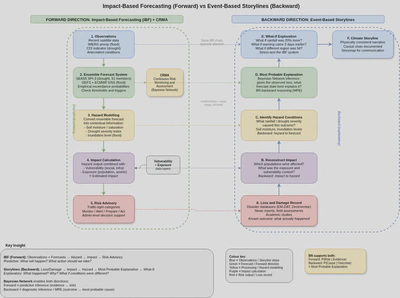
Impact-Based Forecasting (IBF) and event-based storylines both connect hazard to impact, but they travel the impact chain in opposite directions. IBF reasons forward, starting from a forecast and propagating it through exposure and vulnerability to estimate likely impacts. Event-based storylines reason backward, starting from an event or impact of interest and reconstructing the chain of conditions that produced it.
Forward Direction: Impact-Based Forecasting
IBF begins with a probabilistic forecast of a hazard and asks: given this forecast, what impacts are likely, and what actions should follow? It is anticipatory and operational, driving triggers, thresholds, and early action ahead of an event.
Backward Direction: Event-Based Storylines
Event-based storylines invert this logic. They begin with a plausible or observed event and ask: what combination of drivers, exposure, and vulnerability would lead here? This narrative, conditional framing is useful for planning, learning, and stress-testing, exploring how an event could unfold rather than forecasting whether it will.
Why the Contrast Matters
Treating IBF and storylines as inverse views of the same impact chain clarifies their complementary roles: IBF for real-time anticipatory action, storylines for scenario exploration and decision-centric verification. Used together, the forward and backward perspectives reinforce one another across the forecasting and preparedness cycle.